There is a particular look that gives new visitors away at a Thai street food stall. They hover at the edge of the awning. They study the menu board even when there is no English. They wait for someone to greet them in a way that, on a busy evening, is not really going to happen. The stall keeps cooking. The locals keep ordering. The visitor eventually drifts off to a tourist restaurant and assumes the stall was somehow not for them.
This is a small misunderstanding that is easy to fix. Street food in Thailand is a low-friction transaction, not a high-context one. Once you understand the rhythm, you can eat almost anywhere. What follows are the small etiquette habits that mark a visitor out as someone who has done this before — useful in Chiang Mai, useful across the wider Thai street food tradition, and useful for the small dignity of not feeling like a tourist while you eat.
Approaching a Stall
Walk up to the stall. Stand close enough to be seen by whoever is cooking. Make brief eye contact. Smile, or do not, but be visible. The cook will either nod, raise their eyebrows, or ask what you want — usually with a gesture rather than English. That is your cue.
If there is a menu, point to a dish or say its name. If there is no menu, point to a bowl someone else is eating, or point into the pot. Cooks are entirely comfortable with this. Many of the most loved street food stalls in Chiang Mai serve one dish only, which makes the entire transaction wordless — you arrive, you nod, you sit down, food appears in two minutes.
Sitting Down
Most stalls have a few plastic stools set up nearby, often at a shared communal table. Sit anywhere that looks open. You do not need to be shown to a seat. If you are uncertain, point at a stool and look at the cook — they will wave you toward whichever space is free.
Sharing tables is normal. Other diners may sit down across from you halfway through your meal. They will not expect you to talk. A small nod when they sit is enough. If they do start a conversation, it will usually be about whether you like the food, which is an easy question to answer with a smile and a thumbs up.
Using the Cutlery
The default Thai cutlery is a spoon in the dominant hand and a fork in the other. The fork pushes food onto the spoon. You eat from the spoon. The fork rarely goes directly into your mouth. Chopsticks are for noodle dishes only — most other food does not need them.
If your dish comes with sticky rice in a small woven basket, use your hands. Take a small ball with your fingertips, dip it in the accompanying sauce or curry, and eat it from your hand. Sticky rice is not eaten with a spoon. This is the single best way to look like you know what you are doing.
Spice Levels and Add-Ons
If you are uncertain about spice, ask for less spicy — phet noi noi — when you order. Cooks are happy to adjust. They are also happy to leave the dish at its standard level if you do not ask, and in many cases the standard level is genuinely strong. Ask once and you set your range for the whole meal.
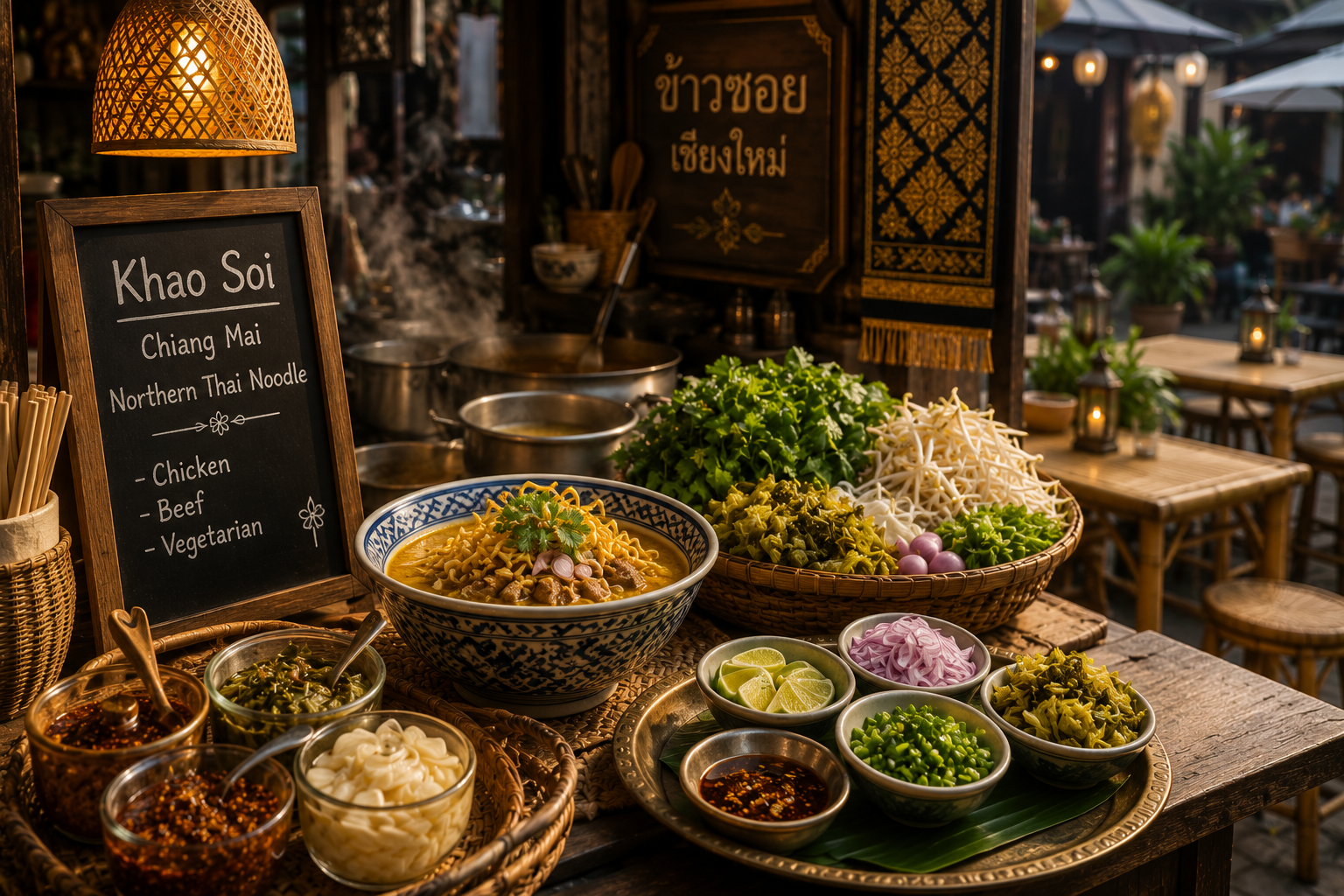
Most stalls put a small tray of condiments on the table — fish sauce with chillies, dried chilli flakes, sugar, and vinegar with chillies. These are for you to adjust your bowl to your own taste. Add small amounts and taste between additions. This is not a salt-and-pepper situation. The four condiments shift the dish in four different directions and locals use them with care.
Paying
Pay at the end, not the start. Either catch the cook's eye and they will come over with a number, or walk up to the stall before you leave and pay there. Cash is universal. Bills of one hundred baht and lower work everywhere. Do not tip on a street stall meal — it is not expected and can confuse the maths. A pleasant thank you in Thai — khop khun — works better than a tip.
Done well, the whole transaction from sitting down to walking off should take twenty minutes and cost less than a coffee at home. Do it once and you understand the appeal. Do it ten times and you stop seeing tourist restaurants the same way ever again.